
 What's on
 Things to Do
 Plan your Visit
 Media Rules and Filming

𝐍𝐀𝐓𝐈𝐎𝐍𝐀𝐋 𝐀𝐃𝐃𝐑𝐄𝐒𝐒𝐈𝐍𝐆 𝐁𝐈𝐋𝐋, 𝟐𝟎𝟐𝟓 𝐆𝐀𝐈𝐍𝐒 𝐌𝐎𝐌𝐄𝐍𝐓𝐔𝐌 𝐀𝐒 𝐌𝐏𝐬 𝐄𝐍𝐆𝐀𝐆𝐄 𝐊𝐄𝐘 𝐒𝐓𝐀𝐊𝐄𝐇𝐎𝐋𝐃𝐄𝐑𝐒







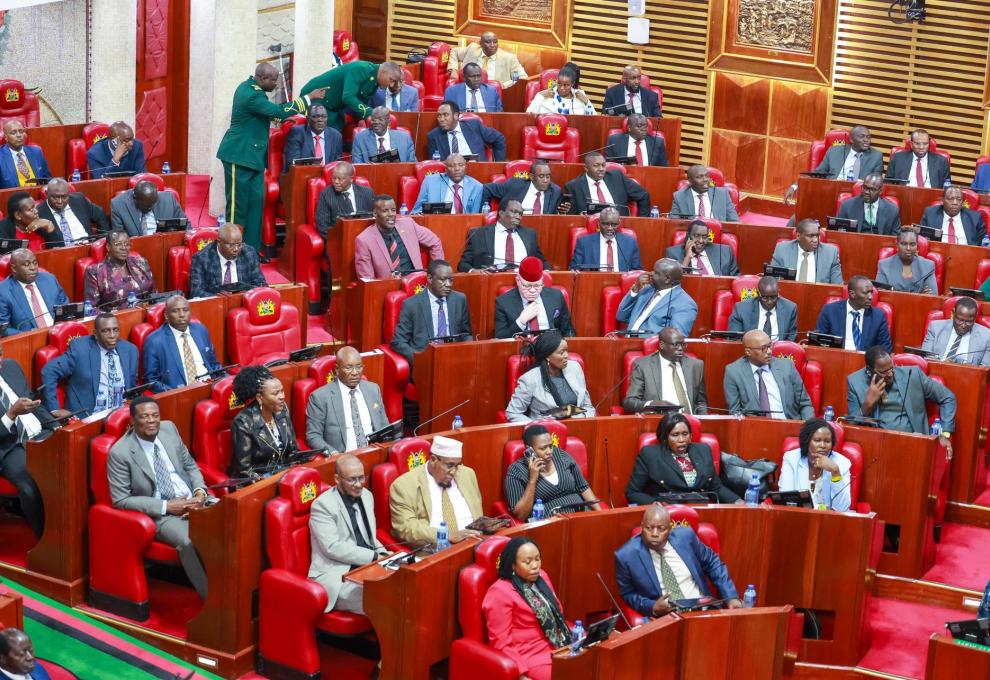
The National Assembly Departmental Committee on Communication, Information, and Innovation on Friday 12th June conducted key stakeholder consultations on the National Addressing Bill, 2025, marking a significant legislative step toward transforming Kenya’s fragmented and outdated spatial referencing systems into a unified, digital-ready national addressing framework.
The Bill is a private Member’s Bill sponsored by Hon. Machua Waithaka (Kiambu) and seeks to establish national addressing standards to streamline critical sectors such as e-commerce logistics, emergency response, security coordination, and service delivery.
During the clause-by-clause stakeholder review, Committee Chairperson Hon. John Kiarie noted that Kenya has lagged in implementing a reliable and integrated national address system.
“As a country, we should have reached a point where we are clear about how we handle our addressing system,” he said, describing the current draft as being at a “green paper stage” ahead of public participation and the second reading in the August House.
Hon. Kiarie further observed that the proposal spans multiple sectors, including information, broadcasting, internal security, housing, land planning, and road infrastructure.
“This is a timely legislative proposal whose time has now come. We have work to prioritize and to ensure its implementation, creating a clear roadmap for the country’s addressing system for prosperity,” said Hon. Erastus Kivasu.
While stakeholders expressed broad support for the Bill’s intent, a key point of contention arose over its governance structure.
The PS State Department for Broadcasting and Telecommunications, Mr. Stephen Isaboke, noted that discussions on a national address system have stalled for nearly a decade, spanning three successive Cabinet Secretaries.
Although offering conditional support, the Ministry raised strong reservations, described as a “showstopper,” regarding Hon. Waithaka’s proposal to establish a standalone National Addressing Council.
The State Department, supported by recommendations from the Communications Authority of Kenya, the Council of Governors, and aligned technical agencies, opposed the establishment of a new entity.
They argued that it would run counter to the government’s fiscal consolidation agenda, which prioritizes the rationalization and merging of state agencies.
Instead of establishing a new council, stakeholders recommended a centralized yet devolved governance model.
The Communications Authority of Kenya, led by CEO David Mugonyi, justified its suitability as the national custodian by citing its mandate under the Kenya Information and Communications Act, its development of technical standards in collaboration with the Kenya Bureau of Standards, and Kenya’s role in representing the country at the Universal Postal Union.
“The important tasks for this Committee on the Bill are to establish a legal framework that ensures efficient implementation, while the Authority is uniquely positioned to serve as the national custodian and coordinator of the addressing system, given the existing mandate,” said Mr. Mugonyi.
On the other hand, the government departments of Security, Land, and Development underscored the cross-cutting importance of a standardized national address database as critical infrastructure for national development.
From the Interior and National Administration docket, Deputy Chief State Counsel Prisca Wambui strongly supported the Bill, citing its potential to improve emergency response, disaster management, and administrative efficiency.
However, she emphasized the need for robust data privacy safeguards.
The State Department for Housing and Urban Development stressed that addressing should not operate as a parallel administrative system. Instead, it must be fully integrated into county spatial plans and development control frameworks to curb unplanned urban growth.
In the Lands and Physical Planning docket, Assistant State Counsel Thomas Peter affirmed that effective land management and registration depend on precise geospatial identification, reinforcing departmental support for the proposal.
Officials from the State Department for Roads noted that a unified addressing system would require standardized road and street classification, which would in turn improve infrastructure planning, investment decisions, and identification of accident black spots.
Bridging the Infrastructure Gap to E-Commerce Growth
Defending the Bill, its sponsor Hon. Machua Waithaka drew from his academic experience in International Trade in Texas, United States, recalling how structured physical maps were used before digital navigation tools became widespread. He contrasted this with Kenya’s current reliance on informal “dropped pin” location sharing due to the absence of a structured addressing system.
He further cited global business expectations, noting that Alibaba founder Jack Ma had previously expressed disappointment upon discovering Kenya lacked a formal address system, questioning its scalability for global commerce. He added that major digital logistics platforms such as Amazon depend heavily on accurate and standardized addressing systems.
Hon. Waithaka also observed that the Postal Corporation of Kenya could significantly expand its last-mile delivery business, potentially threefold, if neighborhood postal codes and structured addressing systems are fully implemented.
The newly elected Isiolo South MP, Hon. Tubi Mohammed Tubi, expressed hope that the Bill will streamline the country’s growing logistics system.
Dr. Joyce Bensuda emphasized that the Bill must clearly define implementation, monitoring, and evaluation frameworks. She further proposed embedding the addressing infrastructure within the education sector to support capitation disbursement systems and enhance school tracking.
Hon. Benard Kitur emphasized the need for technological advancement in the addressing sector, drawing on Western experience to enhance efficiency.
Hon. Mumina Bonaya (County MP, Isiolo) raised concerns about weak security systems that may struggle to handle exposed geolocation data, and about instances in which access roads have been encroached upon or illegally developed.
The Committee will now consolidate stakeholder input to refine the Bill, with a particular focus on separating street-naming functions from physical address data management.
The revised draft will then proceed to the public participation stage before further legislative consideration.